Your No 1. Resource Site for Tactics, Strategy and Diplomacy
Used in Risk Board Game and in Real Life
What's on This Site: Use the Site Index
 |
|
Articles
|
 |
|
|
 |
 |
|
|
|
|
|
By Ehsan Honary - Tuesday, January 01, 2008
6955 Views ::
9 Comments :: :: Tactic, Strategy, Beginners
|
|
You have battled your way through the game. It wasn’t easy and you are glad that you have survived. You really want to win. You have now come to a really decisive point. You have an advantage and you don’t want to blow it up.
End-games in Risk are quite tricky. There is only one winner and when you get to a certain stage, a single mistake or a missed opportunity means you will lose the game and leave the trophy for someone else.
Consider the dilemma you may face in the following game where you are playing as Red. You have eliminated a player who was dominant in North America and have cashed in his cards. You have a choice to place armies on the map and carry on with your march. But you want to pause and think for a second. What are your options? How can you make sure that you will win by choosing the best move possible? You don’t want to leave it to chance. You want that trophy really badly!
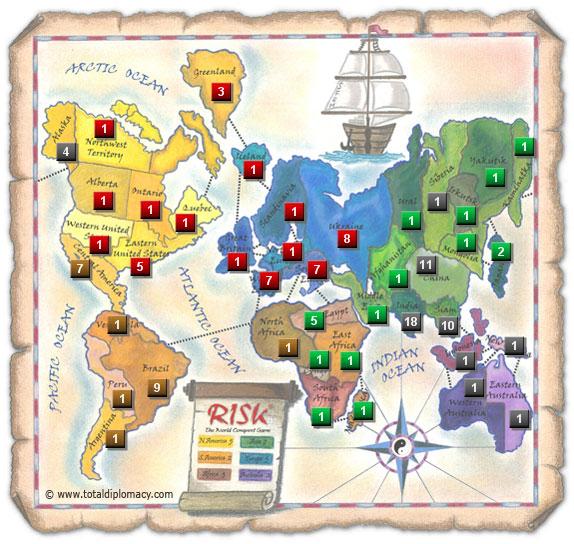
Risk Map: WhoToEliminate_1 --- Open Copy in Risk Map Editor
The game is played with escalating cards 4,6,8,10,… You have received 22 armies that you can place on the map.
Brown, Black and Green all have 4 cards and are likely to have a set. So if you don’t take Brown or Green out, they will come back to cause all sorts of trouble. You think this is a perfect opportunity. You can do a chain; eliminate one player, cash his cards, move on to the next player and so on.
So you decide to start with Brown. You invade South America, remove Brown and cash his cards as planned. Perfect! You think the plan is going really well. That gives you another 24 armies. So you distribute them on the map in strategic places preparing your empire for an attack on Green. You start attacking Africa. However, your luck runs out and you lose many armies in the process. In another front, you attack Alaska and that turns out just as bad. You cannot believe it! Suddenly you realise that this is not going as well as you hoped for and you stop before it’s too late. This is the how the map looks like now.
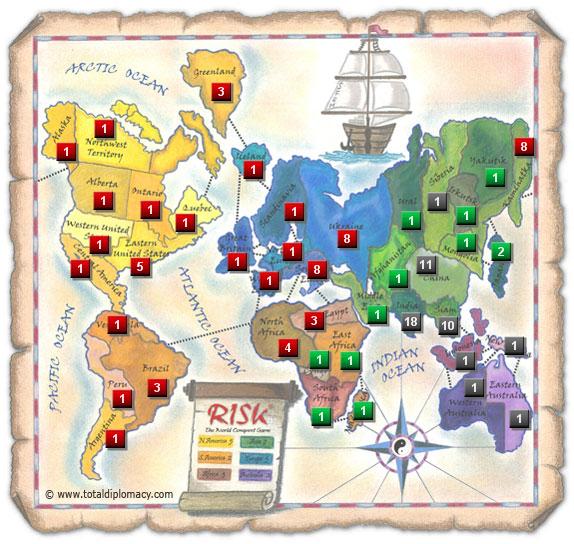
Risk Map: WhoToEliminate_2 --- Open Copy in Risk Map Editor
You realise that you can no longer take Green out. Bummer! He has 4 cards. This is a big problem. The game’s turn order is set to simultaneous. It means that after your turn, Green or Black can play whoever plays first. You simply don’t know who is going to do that. If Black is going to play first and has a set of cards, then he will obviously go for Green to get his cards. Even though you have 5 cards now and will cash them in the next turn, you are not quite sure if you can manage to defend yourself. Of course if Green plays first and if he has cards to cash, he is most likely going to reinforce himself and even attack you. Both cases are bad news for you. Not only this will lengthen the game, but it will put you and Green in a potential conflict to the benefit of Black. You don’t want to believe that you lost because of bad luck. You want to know what you could have done so that, irrespective of luck, you would have ended up in a better position.
Should you have attacked Green instead of Brown? Should you have not attacked any of them and just reinforced? This would have meant that someone else could have cashed and eliminated a weaker player and effectively make a chain potentially attacking you in the process as well.
As it turned out, Black cashed in his cards, eliminated Green, got a lot more armies, invaded Red and eventually won the game.
You lost the game, but you feel you could have had it if it wasn’t because of bad luck. But since you don’t want to blame luck, you wonder what could you have done to end up as the winner or at least recover from bad luck. Of course, sometimes you are just not meant to win the game, but then again, why not?
What do you think? Is it possible to turn the it around, even if you had bad luck? Is dice that critical? Should Napoleon or Hitler blame the cold Russian winters for their failure, or was it that they didn’t account for it properly in their strategies?
|
|
|
|
|
| Comments |
By
samuel chin @
Wednesday, January 02, 2008 12:02 AM
|
|
Ideally, you shouldnt have placed armies near Alaska. Either way I think it's bad luck
|
|
|
By
Grant Blackburn @
Wednesday, January 02, 2008 6:53 PM
|
|
Too bad we can't post the map in this section! Anyway, I think that the intial strategy of placing the extra 22 armies in Western Europe and going through South America that way was a bad idea from the start. I would have placed the extra armies in Eastern US and gone through South America the other way, ending in North Africa. As I march through, I wouldn't leave any armies behind at all (save the mandatory one per territory). I would end up (presumably) with more armies in North Africa to work with. Now, I have 24 additional armies to place and I stand a much better chance at eliminating Green that way. If your objective is to eliminate players and start a chain, then you can't leave armies behind. Focus on your objective. I don't think in this example the player lost because of bad luck, he lost because the plan was faulty in its design.
It is true that you leave behind 7 armies in Western Europe, but truth be told, if you are trying to eliminate a player, it is best that you you pick a point of entry and exit and be sure that your exit point allows you to continue to attack. By ending your attack on Brown in Central America, any armies you end up with there you can't use. By going the other way and not dropping off armies along the way, you stand a better chance to have more armies for the fight later on. Also, the armies in Western Europe could come into play if your attack on Brown goes badly.
Once you eliminate Brown, you now have lots of armies in Europe already to begin your assault on Green. Use them and know that you have Western Europe to fortify with once your turn is done. You can bring armies from that territory to whereever you need defense if you can't ultimately eliminate your opponents.
Have a built in contingency like this is crucial to the plan. Your "Plan B" must also not hinder your primary objective. Risk is about concentrating your resources and completing objectives. That is why it is called RISK. By leaving little puddles of armies in your path, you are trying to hedge your bets, but in so doing, you actually make it much more difficult to achieve your goal.
|
|
|
By
Ehsan Honary @
Saturday, January 05, 2008 7:14 AM
|
|
Sam, Placement in Alaska was important because of removing Black and also preparing for attack on Green from Kamchatka.
Grant, I was wondering if the attack on South America itself was something to reconsider. You seem to agree. A better distribution of armies could have helped. Anticipation is probably the key. Once Brown was eliminated there were lots of armies on the map and eliminating Green felt like an easy task. It was critical at that point (the point where you have lots of armies) to think of Plan B if suddenly your luck ran out and you where left with a small number of armies incapable of completing the goal.
As you suggest, having a Plan B would have been ideal. However the question is what is that Plan B? Suppose you distributed your armies correctly and that you decided to invade Green and remove him only to realise in mid campaign that you won't be able to make it. In this game, you are a victim of your own success, because Black will come to get you.
So going back one step, you have removed Brown, have lots of armies to place, but need to plan for a situation where you may not be able to eliminate Green. What would you do? You don't know if your luck will run out, but you need to be prepared for it. The question is suppose your luck ran out (irrespective of an ideal distribution of armies), what would have been your Plan B?
|
|
|
By
Eugene Turk @
Thursday, January 24, 2008 6:04 PM
|
|
The whole strategy of going after Brown in the first place was flawed. If you look at the layout of Brown vs. Green, Green is weaker. Green has fewer overall armies, and they are more dispersed. Going after Brown first was a big gamble that happened to work out. The two concentrations of 7 and 9 armies could have annihilated the 27 armies (5 + 22) placed on Eastern US with a few lucky defensive rolls. The better play would have been to start with Green with a placement like 20 on Ukraine, 1 on Southern Europe, and 1 on Western Europe. Then Western Europe attacks south one position into West Africa. Using the Southern Europe Army, attack Africa, with the backup in Western Africa. The key is to take Africa with these two armies. If things go well, then the Southern Europe army takes all of Africa, and there will be a glob of guys sitting in W. Africa for the chain attack on Brown. Then with the army of 28 on Ukraine, roll through Green in Asia. Stop to take out Black's one guy in Siberia, and also expend these forces in destroying the 4 armies black has in Alaska. With a total of 14 armies spread out so much, it would require very bad luck indeed not to accomplish this mission. So, let us assume that Green is then eliminated. With Green's cards, trade in and put all 24 armies on Eastern US, for a total army size of 29. Along with any leftover forces on W. Africa, that should be more than enough to destroy Brown, even with the two strongholds of 7 and 9 armies. So, again with cards, if you can trade in, buffer all forces bordering Black's stronghold in Australia. This is the trickiest situation of all. With Black's massive armies there, the key is containment. I would create a wall in Asia along Ural, Afghanistan, and Middle East, and some kind of blockade in Kamchatka as well. The key here will be holding onto continents. You need to rely on holding territories and continents to combat the large troop buildup of Black. The fact that he may be able to trade in cards only adds to the problem. But, with a little luck, any attack by Black can be countered appropriately with the massive territorial holdings resulting from elimination of Green and Brown, and the card army influx.
|
|
|
By
Ehsan Honary @
Thursday, January 24, 2008 8:09 PM
|
|
Thanks Eugene Turk for your inputs. Certainly going for Brown is a valid option. But you need to follow the options the same way as the current exercise. Green and Brown have almost the same number of armies (Brown has only one more army than Green). So as far as probability goes, they are the same. The only difference is that more armies are available in Europe that can be used to eliminate Green. But remember, the problem is not removing Green or even Brown. With the cashed armies both can be removed and since both have 4 cards, you will get the same amount of armies after elimination that you can place on the map.
Now here is the problem: what if you start to attack the second player (in your case, Brown) with the left over armies and found that you are consistently losing armies. Just simple bad luck. This is the same as what happened in the game described in the article when Brown was eliminated and suddenly the luck ran out. What if you realized you can’t take Brown out.
So now you are spread all over the world. Black is ready to explode and so is Brown when he cashes his own cards. You know you can’t remove Brown. But Black can and if he gets a chance he most probably will. If you want to clock Brown from Black, then Brown will simply invade you and you will become weak. Black may also attack you, as he sees you everywhere and suddenly you become the weakest player. So again you are back to the same dilemma. It seems that if you have bad luck in this game, you can’t recover. The questions is would you have been able to follow a “safe” strategy so that even if you had bad luck at this point, the game wouldn’t go in one direction quickly and somehow you can extend it enough to survive and gain more power when you get luckier next time.
What do you think?
|
|
|
By
Eugene Turk @
Monday, February 25, 2008 12:37 PM
|
|
You raise some good points here, but my answer was a direct response to the question framed: "How can you make sure that you will win by choosing the best move possible?" with the additional data: "Brown, Black and Green all have 4 cards and are likely to have a set."
So, as with all Risk games, the key to winning is to take advantage of opportunities when they present themselves. The game scenario put forth is actually a very grim one for Red due to the defensive play of Black which has led to his or her troop accumulations in Asia. As you mention, the odds are that Green and Brown can trade in a set of cards and get 24+ armies on their turns. Either one of these would prove to be much much more difficult to eliminate next turn than this turn. Now is thus the time to strike. The correct play is certainly to take both of them out if possible this turn, because it will be impossible to take out Black this turn. The only reason for waiting at this point, and allowing either Green or Brown to trade in a set of cards would be if one of them was acting as a buffer between Red and Black, however this is not the case. Europe is but a hop and a skip away from Asia here, and due to the unpredictable nature of human motivations, it isn't even guaranteed that Green or Brown won't attack you even though Black is clearly the biggest threat at this point in time.
That being the case, the only way I see for Red to create the best possible scenario to win this game is to try to take out both Brown and Green right now while they have a large number of cards and only have to worry about Black. Your point that bad luck was encountered vs. green is unfortunate, but there is really nothing to be done there. The best strategy in this situation was to attack green, then brown, and hope for the best. If either task failed, then the game was almost certainly lost. It doesn't mean that there wasn't a very good chance of winning with that strategy, probably the best chance given the circumstances. While sometimes in Risk there is the chance to make a play with an excellent fallback plan built-in, sometimes it is just impossible to do so. The reason why it was impossible to make a plan with a great fallback position here is because brown, green, and black all have cards. Brown and green can be taken out by black on his or her turn if black trades in cards before them. This would clearly make black the overwhelming favorite to win. Alternately, if green or brown trades in, the strategy will likely be to go for the player who has not cashed in of that pair. Neither of these scenarios is good for red. Consequently, red should attack green (which is 100% certainly the weaker of brown and green*). If elimination is accomplished, then the next step must be to try to take out brown. If that step is successful, then this game is still not decided, but at least it will be competitive with the large territorial holdings red should now hold. If it is not successful, then the game is almost surely lost, but the correct play will still have been made.
It is definitely possible to make the best play and still lose.
One additional comment I have is that in the scenario as presented, Red stopped attacking due to bad rolls. This is not acceptable in this situation. Due to the possibility of what eventually happened (Black plays first and eliminates Green), Red needs to follow through and use whatever resources he has to continue attacking and try to eliminate green. With the additional troops from trading in, Red can set up the best defense he can imagine and try to withstand the one-turn onslaught of Black. With any luck, due to the card influxes from Brown and Green, Red will get the next big trade in and counterattack to reverse the damage Black will certainly cause on his turn.
* My note here is just to say that dispersal always makes a player weaker if that player has left many instances of 1 army on countries. If I hold 10 countries with 1 army on each, then that will be significantly easier to destroy than one country with 10 armies on it if you assume that the attacker is always going to use 3 attacking armies. This is because the best possible scenario for an attacker is 3 vs 1. This can only occur if the defender has 1 army on a country. Otherwise, it is always beneficial to defend with the maximum of 2 armies. In any scenario with a large army vs. a large defending army, there is a much larger chance of something really unlucky occurring for the attaching army resulting in huge losses and an inability to continue attacking. Thus, with green's largest accumulations of troops being 2 and 5, I would always try to take out green first in this scenario.
|
|
|
By
Ehsan Honary @
Thursday, February 28, 2008 3:56 PM
|
|
Eugene Turk, I see that our discussion is getting more intense :-) I appreciate your response.
Let’s say that I pretty much agree with what you say. I understand what you mean by Green is weaker, since your argument is certainly true. I also agree with the fact that no matter how good your strategy is, you may sometimes lose. This is in fact the main theme of the article. I am trying to explore a number of solutions that could have been employed as a fall back so that despite the bad luck, Red would have survived.
Naturally as you put it well: “While sometimes in Risk there is the chance to make a play with an excellent fallback plan built-in, sometimes it is just impossible to do so. The reason why it was impossible to make a plan with a great fallback position here is because brown, green, and black all have cards.”
That pretty much sums it up. Opponents were too risky to deal with and they should have been eliminated as soon as possible. It’s the inherent feature of Risk that cards bring instability towards the end of the game (which actually makes it quite entertaining).
There was only one thing in your comments that I thought needs more expansion. I still think that Red was right to stop attacking Green once Red realized Green wasn’t going to be eliminated. The reason is that if you know your opponent is going to eliminate a player you were trying to remove, then why should you make his life any easier? Let him spend his armies before he gets his hands on the cards. Of course if you are not sure you can eliminate someone, then you need to evaluate the risk. If not feasible, I don’t see why you should go for it. If you go for it, you may end of stretching yourself too much and weakening yourself in the process.
Eliminating a player usually makes sense when you can get the cards and cash them to protect yourself from backlash. Otherwise if you go all the way, and just leave three territories for the opponent to take, you have spent all the armies, and are now a sitting duck; ready to be taken out in the chain when your opponent starts invading one player after another.
|
|
|
By
Eugene Turk @
Saturday, March 01, 2008 6:23 PM
|
|
Thanks Ehsan for your comments.
To clarify my point about Red stopping attacking, I am just looking at the final game state presented. What I see is 3 armies sitting in Brazil, and 4 in North Africa. This implies to me that a conservative choice was made to stop attacking and leave three armies behind in Brazil after taking North Africa. If the free troop movement had been used instead to create an army of 6 in North Africa, those 6 armies could (and I would argue should) have eliminated green from Africa entirely. The remaining troops green has in Asia can be eliminated through the armies in Kamchatka, Ukraine, and Southern Europe. Because green has 4 cards, after eliminating him it will almost surely be necessary to trade in cards per the rules I have used recently, so red will get 24+ armies to fortify and attempt to withstand black's onslaught. Yes, from one perspective it is silly to try and do another player's work for him or her, but in this case, to fail in the task of eliminating green is to hand the game to black. Yes, it will be risky with armies of merely 3 (Egypt) and 6 (N. Africa) to attempt to take out 4 solitary countries in Africa with 1 army on them each, but it is a Risk that might pay off with a victory in the case presented. There are no alternate paths to victory here than a gamble and a prayer.
But in general I absolutely agree that letting players weaken themselves through conflict which does not result in the elimination of a player is beneficial to those not participating in the conflict. However, as the three players in question each have 4 cards, I'm sticking with my original intuition here.
Thanks again for the comments and great site. I'll have to pick up your book.
|
|
|
By
Ehsan Honary @
Saturday, March 01, 2008 7:28 PM
|
|
Yes, you are quite right Eugene Turk about the risk taking. That's exactly how Red felt when he stopped attacking that there is no hope to kill Green.
Naturally, since Red went on to lose anyway, it might have been a good gamble to try to eliminate Green if he could suddenly get lucky. At least that way he would have a chance. Otherwise he would have lost anyway. That makes sense and I agree with you. The name "Risk" is the best explanation.
And of course it would be my pleasure if you read the book and of course would look forward to hear your views. Thanks
|
|
|
You must be logged in to post a comment. You can login here
|
|
|
|
|
 |
 |
 |
 |

|
|