History has many lessons to teach us and when it comes to strategy and you can get a lot of insight from it. In 1218, Khwarezm was a prosperous empire covering modern day Iran and Afghanistan. Shah Mohammad II ruled from his wealthy capital of Samarkand. At this time, the Mongols on his East approached him to make a deal on reopening the Silk Road. This would bring even more wealth, to the empire so Shah agreed to it.
Later, Mongols sent an envoy to buy expensive gifts for their court from the empire. Shah suspected the convoy as spies and killed them all. Genghis Khan, leader of Mongols responded by sending their ambassador to the Shah requesting an apology. Shah did not consider the Mongols as an equal power, so he was outraged by a request to apologise. He had the ambassador killed as a symbolic move to show that he was in charge of a superior empire. Naturally, this meant war.
The Shah was not afraid. He had a large cavalry numbering 400,000 which he could deploy to annihilate anyone entering his empire. He deployed his forces to the eastern part of the empire along a 500 mile long Syr Dar’ya river.
The north was blocked with the impassable Kizil Kum desert and the south route would be too long a detour for any invasion force. The Shah thought that his defensive position was implacable and he could resist anything.
A year later, news came that the Mongols were attacking from the south. The Shah sent his son with a large army to deal with them. After a bloody battle, the Mongols retreated and the son returned victorious. He reported that the Mongol army wasn’t really as strong as they thought. They concluded that the Mongols were no match for the Shah’s army.
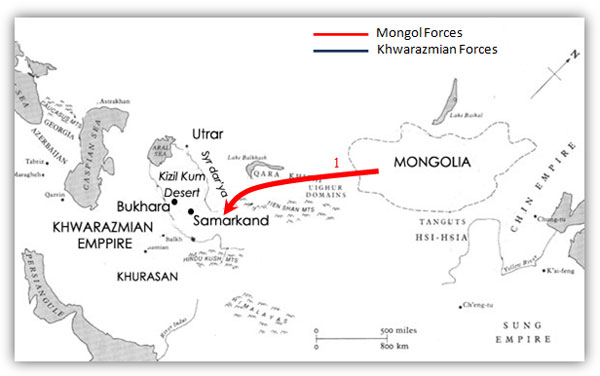
A couple of months later, a Mongol battalion attacked the city of Utrar to the north and captured their governor. This was the same city that the Mongolian convoy went to with their eventual death. To make their mark, Mongols poured molten silver in the eyes and ears of the governor! The Shah thought that the north side could prove weak, so he sent more armies along the river to the north to protect it.
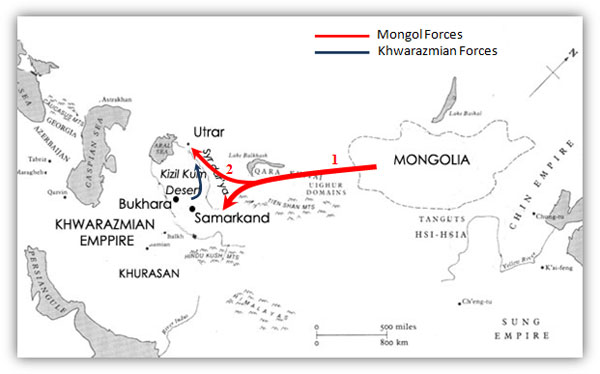
Next, two fast moving Mongol armies started moving parallel to the river attacking cities one after another. They ransacked and destroyed everything on their path creating fear and devastation which came to symbolise the Mongolian attacks. Another Mongol army moved to the south creating mayhem. The Shah started to get a clearer view of what was happening. The Mongols were fast. Each Mongol rode a horse along with several riderless horses that he could use when his horse got tired. They carried their own supplies, and used the weak horses for food. As a result, there were no supply lines necessary and the armies could move incredibly fast from one city to the next.
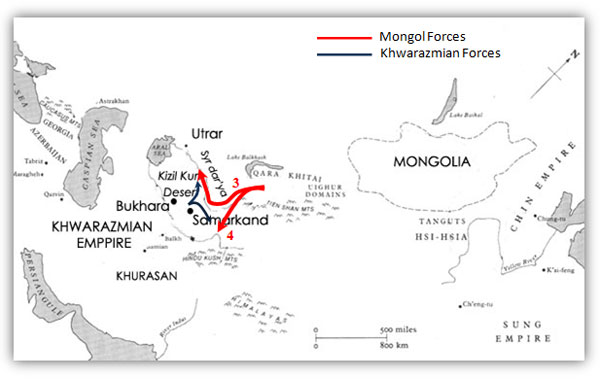
Suddenly, the army in the south switched direction and aimed for north with remarkable speed. The Shah sent his last reserves of 50,000 to battle it, still confident that his forces were superior to the barbarians. To his horror, he discovered that the Mongols used all sorts of strange weapons, arrows tipped in tar, smoke to create fog of war and heavy silk as body armour which made it difficult to pierce arrows through them.
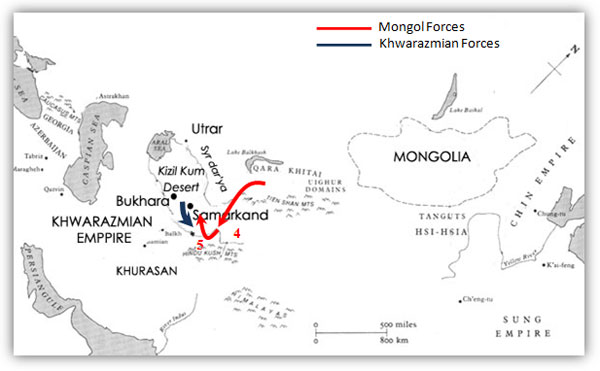
This was becoming overwhelming. The Shah decided that he needed to retreat to the west and regroup. By now his forces were scattered north and south chasing various Mongol armies. As he was preparing for this move, he was suddenly confronted with the most improbable event. Genghis Khan himself arrived at the gates of the city of Bokhara, west of Samarkand. He was shocked. How did they get there? He had the way to the west completely blocked. He already had forces to the north and to the south and the middle was protected by his two largest cities, Samarkand and Bokhara. The only path left was the desert and that was impassable. Bokhara fell, followed by Samarkand and followed by the rest of the empire. The Shah of the wealthiest empire in the east escaped with a handful of loyal soldiers and eventually died of hunger a few months later!
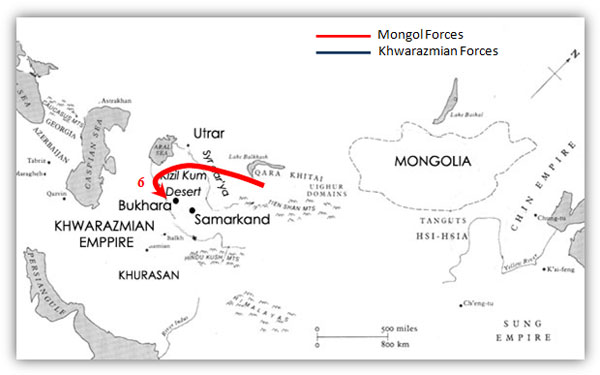
How did Genghis Khan do it? What strategy did he use that was so overwhelmingly effective? How can you relate this to Risk?
Provide your views here before reading the next part of the article.
Part 2: What can You Learn from the Mongol Invasion?