This is the last part of the 3-part series. As you saw earlier, many players suddenly made bold moves and expanded in different directions. The cards meant that the game was unstable and anything could happen. The above shows how the world looked like.
As you may have guessed Green got greedy. His expansion at this stage of the game was completely unnecessary. In escalating games, where cards values continuously go up, continents become less and less attractive as the game progresses. In this case, both Green and Yellow made big mistakes. Green simply spent a large amount of armies to hopefully, sometime in the future, get control of the North American continent. That would have not happened until another 2 turns and even then he would have only got 5 more armies per turn. It’s like going for a costly war and only get little amount of resources in the new land or that you need to wait another 3 turns before you can reclaim the cost of your war.
Yellow did a similar mistake by going for a small continent fighting against all those neutral armies. He thought he is still powerful with his 19 armies at the end of him move, not realising that the hidden power is far more critical at this stage. The kind of power he simply did not have any more. Do you know what this hidden power is?
Towards the end many players, almost at random, can cash in and attack. To stay alive you have to constantly manoeuvre around so that they don’t attack you and instead attack someone else. That’s the essence of staying in the game. It’s absolutely critical to think of the following:
- What happens if each player cashes their cards?
- What happens if a player gets eliminated and his cards are handed over to the eliminator?
Failure to have a clear understanding of this is a guarantee for elimination. Most players don’t think as far and unfortunately most lose. Be agile, and move around the map looking for elimination all the time! Do you now see where the hidden power is? If not, read on.
So back to the example, Cyan decided to cash in and attack Green.
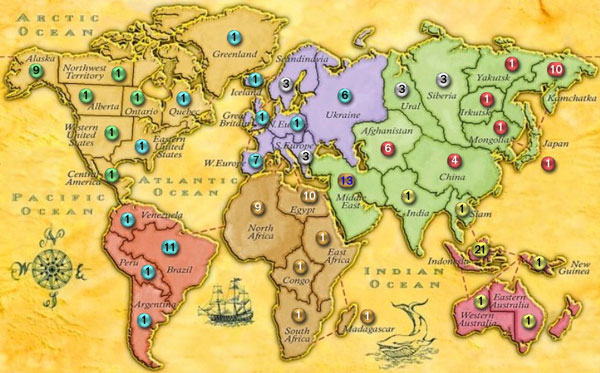
Green was already weak so Cyan thought that going for his continent is a great idea. He even went on to offer the same treaty over Brazil-North Africa border to Brown! In effect, Cyan was using the same strategy that Green was using in the beginning of the game. Of course that era was over, and Cyan was simply like an old army against with old tradition against a more agile and technologically advanced power (think cavalry in perfect formation against guerrilla warfare!).
The Final Showdown:
Brown cashed in the cards and attached Yellow for elimination. Got 4 cards, cashed in and eliminated Red. Got another 4 cards, cashed in and eliminated Green and then Cyan. All finished in one move! They all failed to see that the world had changed and that their successive elimination is what they had to protect against and going for a mere Australian continent wasn’t going to them any good.
Now, do you see where the hidden power is? It is the ability to eliminate others. Yellow used up his resources and isolated himself in the far corner of the map; exactly the opposite of what a player should do at this stage. Others failed to see or protect themselves against the elimination of another player which would give the eliminator a lot of cards and armies.
To sum up, use agility, think 3 moves down and always consider the next move made by every other player; to be eliminated or not. Hence, Do Not Fight the Last war.