When playing Risk, you can generally adopt three kinds of strategies; passive, aggressive or assertive. Each of these has its own style of play and has certain consequences. It is well known that in order to successfully communicate with others, you need to be assertive and this also applies to Risk as well. However, what does it mean to be assertive? How can you optimise your strategy to take advantage of the benefits of assertiveness?
In this article you will be introduced to the APA model (Assertive, Passive & Aggressive) and explore various issues and parameters that you must be aware of when you are dealing with other Risk players.
First let’s look at the definition of assertive communication. The purpose of an assertive communication is to:
Be in control of the situation and communication,
while,
keeping communication channels open and flexible
Naturally, an assertive tone sounds confident. Confidence comes from knowing what you want and where you want to go. Confident people always seem to have a clear mission, a goal that will come to define their behaviour. A confident player is taken much more seriously. Stronger players will think twice before attacking a confident player who knows what he is after. Indeed, you want to portray the image of a person who is on top of the game and has a grand plan.
You may argue that an aggressive person may also portray the same confidence. What is bad about appearing as an aggressive player? Isn’t that what you need to do to win the game anyway? To find the answer to these questions, we can look at the APA model in more detail to better understand the differences between the three strategies. The following is the full spectrum of possibilities when it comes to people’s rights:
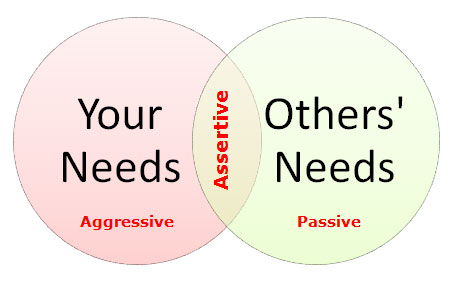
As you can see, a person who only considers his own needs takes an aggressive stance. Conversely, a person who only considers other’s needs at the expense of his own is generally considered as passive. None of these styles are productive. However, as you gravitate towards the centre, you start to consider everyone’s needs and this is where an assertive person stands. In short, the distinction is defined based on rights:
- Passive: You are more concerned about others than yourself
- Aggressive: You are more concerned about yourself than others
- Assertive: You are concerned about yourself and others
In other words, a passive person is likely to give up his rights when threatened. Needless to say, this may easily lead to disaster. No one will be interested to hear a passive person’s side of the story when negotiating and he can be easily picked on as a weak player and eventually kicked out of the game.
Most excessively dominant or aggressive people are seen as bullies. Deep down, bullies are very insecure people. They dominate because they are too insecure to allow other people share their ideas or have any influence. In Risk, an aggressive player wants to win at all costs. Indeed, it is quite possible to win one single Risk game this way. However, you reputation as an aggressive player can prove to be lethal in the long run when you want to play more than one game. An aggressive player can benefit more when confronted with a passive player. However, an aggressive person will not gain much against an assertive one, since an assertive player may appear just as firm and tough as the aggressive player. When the assertive player confronts the passive, there is more chance for success and mutual cooperation leading to more cooperative game play. Similarly, two assertive players are likely to be more cooperative and gain more as a result in composition with two aggressive players against each other who just go for the kill. In short, in a population of assertive, aggressive and passive players, assertive players have the highest chance to win.
The best way to learn how to be assertive when confronting other players is to know the difference between the three styles as illustrated below:
Passive
- Uses apologetic word such as “Sorry about that attack”, “I am afraid I need to do this”, “Terribly sorry for my move”, …
- There is a lot of uncertainty in the sentences delivered, emphasised by words such as, “possibly”, “may be”, “if possible”, “perhaps” and “not sure”.
- Brings himself down in comparison to other players by stating “I am very new to this game and not very good at it”, “You obviously know more about this than I do”, “I have never done this before”, “It’s my mistake really”
- Expects permission and may ask directly for this. For example, “Can I move my armies here?”, “Do you mind if I go ahead?” and “Is this OK with you?”
- Dismisses his own needs. For example, “I don’t really need this continent anyway now that it’s been attacked”.
- Very few “I” statements are used in sentences.
Aggressive
- There are many accusations in the language.
- The sentences are full of “I” statements. It is all about the player who is delivering the request.
- The language is threatening. There can be many “if” statements which lead to punishment if the request is not satisfied. For example, “If you don’t move your armies, I am going to attack you”, “You are a newbie, you just haven’t got a clue how to play”, “You are %#%£.”
- Opinions are delivered as facts. For example, “If I lose it’s because you randomly picked on me.”, “You just ruined my game. Bunch of %$£%%$”.
- The sentences are emotionally charged with words inserted to fuel the conflict rather than to control it.
- Sarcasm and mockery is used to level the ground for further attacks. For example, “We should ban this player who doesn’t know how to play”, “Hah, if they could only play”
- Forceful words such as “must”, “should”, “will” and “ought” are used frequently.
Assertive
- Sentences are well composed and logical.
- There seems to be a solid structure to the reasoning and the request is well thought.
- Statements are clear and concise. The receiving end has no problem understanding what is wanted of them.
- The person seems to care about the opinion of others and is willing to compromise as necessary to achieve the higher aim
- “I” statement are present but are used sparingly when appropriate.
As a guide, to be assertive use the following guidelines:
- Be direct: Get to the point as clearly as possible and deliver it confidently
- Be brief: Less is more. Don’t confuse the other person by extra details or vague conservative requests. Deliver you request and stop.
- Provide reasons: To support you requests, provide a number of rational reasons. Make sure to present concise reasons that are directly related to your request.